
"This is a release that offers both the pinnacle of choral singing, and a message of real importance."
This article originally appeared in Issue 50:1 (Sept/Oct 2026) of Fanfare Magazine.
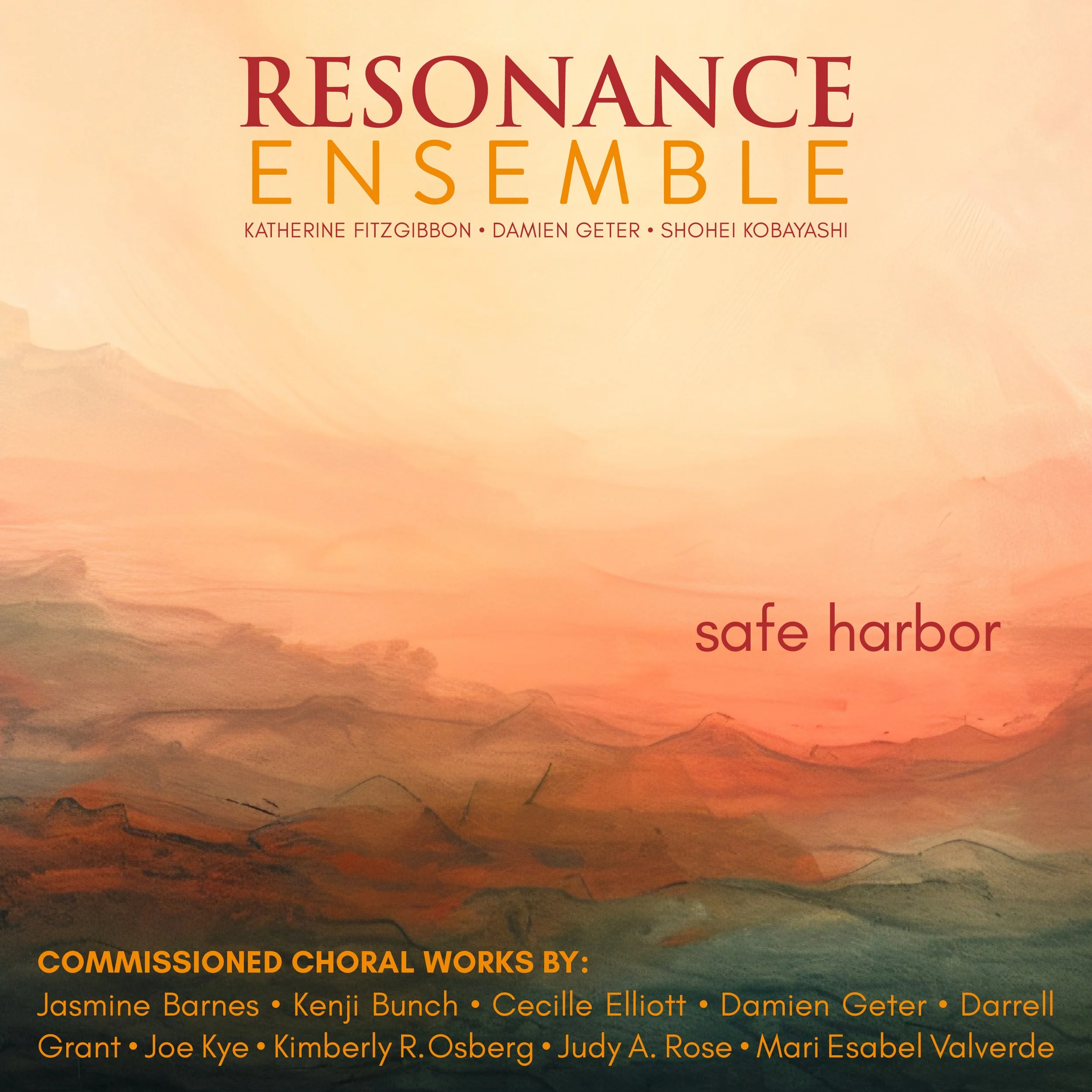
There is so much to admire about this release, both on a moral/ethical level of inclusion/exclusion, immigration, and “home” and much more (see interview above), and from the performative aspect. The close (but not invasive) recording supports Resonance Ensemble’s preternatural exactitude of execution. The very first track seems designed to illustrate all of this: Cecille Elliott’s We Are Murmurs (2023), launched by melodious humming before the first line (“We are murmurs calling out”). The words, by the composer, are inspirational (“we are starlight,” for example) couched in contemporary five-part jazz. Words are completely intelligible, always, something which is a Resonance core trait.
The two discs have different focuses: the first, REflect, so a looking back; the second, REimagine, offering possible, brighter futures. Part of the first disc’s reflection is the Spiritual: Damien Geter’s version of “There’s A Man Goin’ Round” is powerful. These are ominous lyrics (“There’s a man goin’ round taking names …He has taken my mother’s name”). Geter layers lines, juxtaposing that with either solo voice or unison choral statements. The mononymical Onry is the male soloist, absolutely superb, ably supported and elaborated on by Madeline Ross. The performance could not be more heartfelt. An extension of those lyrics, perhaps, is found in the very next item, The Talk. The above interview explains this poignantly: The full title is The Talk: Instructions for black children when they interact with the police. The setting is clever: “Keep your hands where they can see then” is illustrated by clapping (something which would be doubtless even more effective in live performance when one can see the performers). Nicole Joseph is a powerful soloist here.
The Book of Sankofa, Part One: Words She Would Have Us Know features its librettist, A. Mimi Sei, as speaker. Sankofa is a Ghanaian word of complex meaning, a return to roots, a Rückblick to illuminate the future, perhaps. An instrumental aspect underlines the choral activity, while a solo cello (Nancy Ives) adds a certain poignancy. The speaker is closely placed: the message cannot be missed. Musically, this is not the most inspired piece on the release, however: it seems rather word-bound, painting from moment to moment. While the sentiment is more than laudable, to reach back to our ancestors for wisdom, this quarter-hour piece carries less emotive punch than each of the three before it. The piece does segue nicely into the vocal/instrumental aggregate that opens Geter’s After Time Has Gnawed Away the Shield of Dreams, out of which Geter’s voice emerges. Scored for choir comprising 16 voices, flute, and piano, and with words by James DePreist, the piece flows from section to section beautifully, mixing thorny harmonies with the most beautiful delineated song. Sopranos are superb when asked to be mobile; flute curlicues enhance the whole. A lovely, powerful piece in which narration also plays a part (Maria Collinsworth, Cecily Kiester, and Dereau K. Farrar, speakers).
The final track of the first disc is the titular Safe Harbor by Joe Kye. The piece, which centers on immigration, is clearly personal: Kye himself is an immigrant from Korea. A lullaby from the composer’s mother inspires the music; instrumental plucked sounds and pentatonic melodies usher us into Korean territory. The piece acts as summary of the release’s concerns and as a distillation of the essence of it. Maria Collinsworth is superb in her solos, while the way other voices join her at “Remember me” and “don’t forget me” is highly effective. This is a poignant, musically rich close to the first disc, perfectly realized, not least in the isolated single words in the choir against pizzicato and arco strings. This is a stunning work, and a finer performance is unimaginable.
… and so to REimagine: alternative paths, brighter futures. The upbeat Normal Never Was is immediately engaging. Scored for SATB choir, Jasmine Barnes’s 2020 setting of Sonya Renee Taylor moves from boppy to an exploration of the normalization of greed. Mari Esabel Valverde’s We Hold Your Names Sacred is an incredibly touching piece of music that is part of the Social Justice movement. The names of transgender sisters of color who have been taken are listed: the effect is unforgettable. Harmony is expressively used, with notable arrival points underlined by piano (Hannah Brewer, whose contributions throughout are ever-sensitive). The work was commissioned by Resonance Ensemble in conjunction with an exhibition of the paintings of Henk Pander (which depicted scenes in the wake of the murder of George Floyd) and also with an historic flood that devastated an area occupied mainly by people of color. S. Renee Taylor’s text is beautifully profound in Seek What You Want To Find; the music visceral; the title refers to interpretation of events: “even in death, in disorder, in a forced passage, Hope is always there.” The solo voices, overlapping as if bursting with anxiety, are provided by Cecille Elliott, Madeline Ross, John F. Cox, and DeReau K. Farrar. String dissonances mirror the pain (the very first indication in the score is Dark, cold). A version (with piano reduction of the string quartet) can be found in a free PDF download at the composer’s website.
The arrival of the Agnus Dei from Geter’s African American Requiem is perfectly placed: it seems to command us into a space where “Dona eis Requiem” is both necessity and soul-felt demand. It also offers Resonance Ensemble an opportunity to show off the richness of its choral sound, so perfectly blended and yet with every detail audible. And what an affecting harmonic twist Geter brings to “qui tollis peccata mundi.” The jazzier follow-on is unexpected but all the more welcome because of that, stratospheric sopranos flying over the hocketing lower voices. It is of course important to note that here, as on the first disc, the composer conducts his own works.
The concerns of Vin Shambry’s poem RE-FLEC are vital, of how racism is addressed (and vital not just to the USA), and there is no doubting the red-hot intensity of Judy A. Rose’s dramatic setting. The musical vocabulary is vast, and yet perfectly integrated and balanced. Finally, we have Kenji Bunch’s setting of A. Mimi Sei, Shout Out. The confluence of these two people was perfectly timed: Bunch was experiencing burnout, and Sei’s poem lifted him. Scored for choir and solo cello (Valdine Mishkin), it closes Safe Harbor. The cello is a melancholy soliloquizer, the choir at once illustrating and celebrating a shift from the individual to the power of the collective.
If ever there was a release that was greater than the sum of its parts, it is this one. This is a release that offers both the pinnacle of choral singing, and a message of real importance. Booklet notes are to be found online, but the physical product is beautifully designed, and hearing this through speakers as opposed to streaming adds much to the music’s impact. Recommended. Colin Clarke