
Posts tagged James DePreist
"This is a release that offers both the pinnacle of choral singing, and a message of real importance."

This article originally appeared in Issue 50:1 (Sept/Oct 2026) of Fanfare Magazine.

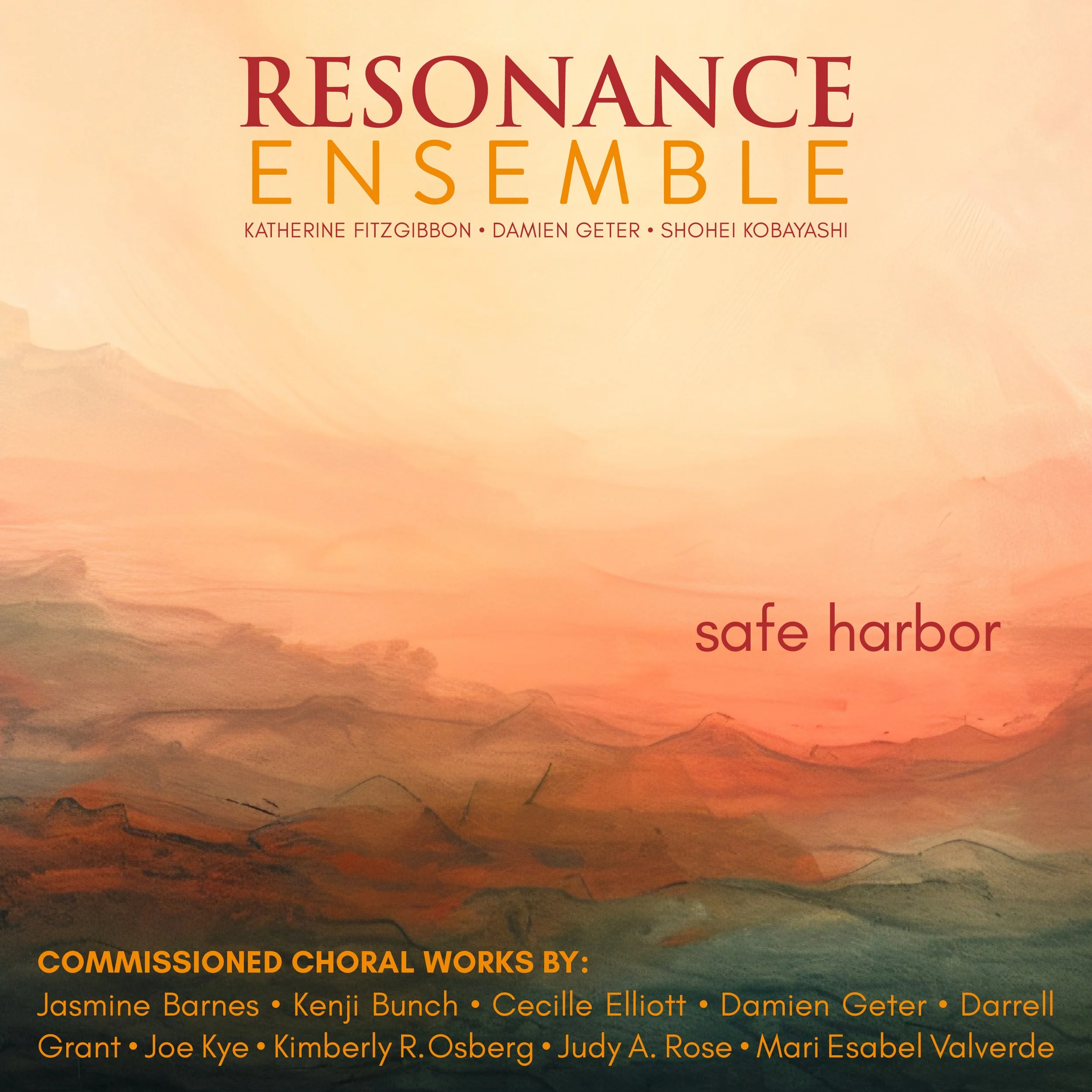
There is so much to admire about this release, both on a moral/ethical level of inclusion/exclusion, immigration, and “home” and much more (see interview above), and from the performative aspect. The close (but not invasive) recording supports Resonance Ensemble’s preternatural exactitude of execution. The very first track seems designed to illustrate all of this: Cecille Elliott’s We Are Murmurs (2023), launched by melodious humming before the first line (“We are murmurs calling out”). The words, by the composer, are inspirational (“we are starlight,” for example) couched in contemporary five-part jazz. Words are completely intelligible, always, something which is a Resonance core trait.

The two discs have different focuses: the first, REflect, so a looking back; the second, REimagine, offering possible, brighter futures. Part of the first disc’s reflection is the Spiritual: Damien Geter’s version of “There’s A Man Goin’ Round” is powerful. These are ominous lyrics (“There’s a man goin’ round taking names …He has taken my mother’s name”). Geter layers lines, juxtaposing that with either solo voice or unison choral statements. The mononymical Onry is the male soloist, absolutely superb, ably supported and elaborated on by Madeline Ross. The performance could not be more heartfelt. An extension of those lyrics, perhaps, is found in the very next item, The Talk. The above interview explains this poignantly: The full title is The Talk: Instructions for black children when they interact with the police. The setting is clever: “Keep your hands where they can see then” is illustrated by clapping (something which would be doubtless even more effective in live performance when one can see the performers). Nicole Joseph is a powerful soloist here.

The Book of Sankofa, Part One: Words She Would Have Us Know features its librettist, A. Mimi Sei, as speaker. Sankofa is a Ghanaian word of complex meaning, a return to roots, a Rückblick to illuminate the future, perhaps. An instrumental aspect underlines the choral activity, while a solo cello (Nancy Ives) adds a certain poignancy. The speaker is closely placed: the message cannot be missed. Musically, this is not the most inspired piece on the release, however: it seems rather word-bound, painting from moment to moment. While the sentiment is more than laudable, to reach back to our ancestors for wisdom, this quarter-hour piece carries less emotive punch than each of the three before it. The piece does segue nicely into the vocal/instrumental aggregate that opens Geter’s After Time Has Gnawed Away the Shield of Dreams, out of which Geter’s voice emerges. Scored for choir comprising 16 voices, flute, and piano, and with words by James DePreist, the piece flows from section to section beautifully, mixing thorny harmonies with the most beautiful delineated song. Sopranos are superb when asked to be mobile; flute curlicues enhance the whole. A lovely, powerful piece in which narration also plays a part (Maria Collinsworth, Cecily Kiester, and Dereau K. Farrar, speakers).

The final track of the first disc is the titular Safe Harbor by Joe Kye. The piece, which centers on immigration, is clearly personal: Kye himself is an immigrant from Korea. A lullaby from the composer’s mother inspires the music; instrumental plucked sounds and pentatonic melodies usher us into Korean territory. The piece acts as summary of the release’s concerns and as a distillation of the essence of it. Maria Collinsworth is superb in her solos, while the way other voices join her at “Remember me” and “don’t forget me” is highly effective. This is a poignant, musically rich close to the first disc, perfectly realized, not least in the isolated single words in the choir against pizzicato and arco strings. This is a stunning work, and a finer performance is unimaginable.

… and so to REimagine: alternative paths, brighter futures. The upbeat Normal Never Was is immediately engaging. Scored for SATB choir, Jasmine Barnes’s 2020 setting of Sonya Renee Taylor moves from boppy to an exploration of the normalization of greed. Mari Esabel Valverde’s We Hold Your Names Sacred is an incredibly touching piece of music that is part of the Social Justice movement. The names of transgender sisters of color who have been taken are listed: the effect is unforgettable. Harmony is expressively used, with notable arrival points underlined by piano (Hannah Brewer, whose contributions throughout are ever-sensitive). The work was commissioned by Resonance Ensemble in conjunction with an exhibition of the paintings of Henk Pander (which depicted scenes in the wake of the murder of George Floyd) and also with an historic flood that devastated an area occupied mainly by people of color. S. Renee Taylor’s text is beautifully profound in Seek What You Want To Find; the music visceral; the title refers to interpretation of events: “even in death, in disorder, in a forced passage, Hope is always there.” The solo voices, overlapping as if bursting with anxiety, are provided by Cecille Elliott, Madeline Ross, John F. Cox, and DeReau K. Farrar. String dissonances mirror the pain (the very first indication in the score is Dark, cold). A version (with piano reduction of the string quartet) can be found in a free PDF download at the composer’s website.

The arrival of the Agnus Dei from Geter’s African American Requiem is perfectly placed: it seems to command us into a space where “Dona eis Requiem” is both necessity and soul-felt demand. It also offers Resonance Ensemble an opportunity to show off the richness of its choral sound, so perfectly blended and yet with every detail audible. And what an affecting harmonic twist Geter brings to “qui tollis peccata mundi.” The jazzier follow-on is unexpected but all the more welcome because of that, stratospheric sopranos flying over the hocketing lower voices. It is of course important to note that here, as on the first disc, the composer conducts his own works.

The concerns of Vin Shambry’s poem RE-FLEC are vital, of how racism is addressed (and vital not just to the USA), and there is no doubting the red-hot intensity of Judy A. Rose’s dramatic setting. The musical vocabulary is vast, and yet perfectly integrated and balanced. Finally, we have Kenji Bunch’s setting of A. Mimi Sei, Shout Out. The confluence of these two people was perfectly timed: Bunch was experiencing burnout, and Sei’s poem lifted him. Scored for choir and solo cello (Valdine Mishkin), it closes Safe Harbor. The cello is a melancholy soliloquizer, the choir at once illustrating and celebrating a shift from the individual to the power of the collective.

If ever there was a release that was greater than the sum of its parts, it is this one. This is a release that offers both the pinnacle of choral singing, and a message of real importance. Booklet notes are to be found online, but the physical product is beautifully designed, and hearing this through speakers as opposed to streaming adds much to the music’s impact. Recommended. Colin Clarke

Mark Gabrish Conlan reviews Safe Harbor by Resonance Ensemble for Fanfare Magazine

This article originally appeared in Issue 50:1 (Sept/Oct 2026) of Fanfare Magazine.

On June 2, 2019 a young Black man named Miles Hall with a history of mental issues was shot and killed by police officers in his parents’ home in Walnut Creek, California. I only knew this because my husband, Charles Nelson, was Miles Hall’s uncle and my mother-in-law Edi was the person who called the police, expecting they would help him. Instead they shot him dead. Before that I was intellectually and ideologically a supporter of the Black Lives Matter movement. After that, it was something that had touched my family, and therefore me, personally.

I tell this story at the beginning of my review of the Resonance Ensemble’s stunning new two-CD set Safe Harbor because the music and (especially) the texts of the 12 works on this album directly relate to it. The first time I played the album with the texts in hand, I literally started crying as the memories of Miles Hall’s death—including Charles’s reaction to it (he called me and asked me to meet him at the bus stop he got off at on his way home from work so he could unburden himself of his trauma)—started flooding back to me.

The Resonance Ensemble is based in Portland, Oregon (though there are others in New York, Nebraska, and Christchurch, New Zealand) and is about to present its 18th season. According to their website, “Through thoughtful, thematic concerts, Resonance amplifies voices historically excluded from the stage—highlighting underrepresented composers, poets, visual artists, and community collaborators.” Their artistic director, Katherine FitzGibbon, has created a remarkably flexible vocal group that can perform in virtually any style, from the white British glee club tradition to just about all African-American music and, in the title work on this album, Asian traditions in general and Korean in particular.

Their home city, Portland, was the site of the longest demonstrations in the U.S. against the murder of African American George Floyd (1973–2020) by police in Minneapolis, Minnesota. Nowhere else in the country, not even in Minneapolis, did the protests against the Floyd murder last as long as they did in Portland. And nowhere else did they generate so much violence, largely at the instigation of counter-protesters who attempted to disrupt the Black Lives Matter demonstrations and frequently aligned themselves with President Donald Trump’s 2020 re-election campaign.

Many of the works on Safe Harbor were commissioned by Resonance Ensemble for Portland Protests, a 2023 concert they gave to honor the Portland demonstrators and their overall commitment to justice and peace. One of the works, “From The Book of Sankofa, Part 1: Words She Would Have Us Know,” is based on sankofa, a word from Twi, the language of the Akan tribe in Ghana (the country, along with the adjacent Gold Coast, that was the source for more African-American slaves than any other site in Africa) that literally means, “Go back and get it.” Composed by Black pianist and composer Darrell Grant to a text by A. Mimi Sei, this piece relates to the way slaves used the word sankofa to maintain connection with their African heritage and culture even while their white owners tried to break them and “season” them to accept permanent servitude.

Grant’s eclectic list of influences on this work includes Thomas Tallis, The Staple Singers, Herbie Hancock, modern classical composer Caroline Shaw, Schubert, Bobby McFerrin, and Ravel, “among others.” Grant says he hopes the work “provides listeners an opportunity to reflect on the questions of what we will pass on, what we must sacrifice, and what must we always remember in order to realize the dreams we hold for ourselves, our children, and our communities.”

Another major compositional talent showcased here is Damien Geter, who’s featured in two excerpts from his An African American Requiem as well as two stand-alone works. The African American Requiem excerpts include his arrangement of the traditional spiritual “There’s a Man Goin’ Round Takin’ Names,” which he used to open the “Liber scriptus” movement, and a setting of the familiar Latin Agnus Dei text. While my favorite version of “Takin’ Names” remains the one I learned it from—the remarkably dramatic solo record by bass-baritone Paul Robeson and pianist Alan Booth—Geter’s setting is an effective showcasing of the multiple meanings of “The Man” as a symbol of white oppression.

Geter’s portrayal of how African Americans continually live under the shadow of white domination becomes more explicit in The Talk: Instructions for Black Children When They Interact with the Police. As a white boy growing up in suburban Marin County, California, I didn’t have to learn to be afraid of the police. I was trained to regard them as helpful older men. Black boys and girls aren’t so lucky; their parents have to train them to treat the police as potential oppressors and even potential murderers. Geter’s text for The Talk runs, “Pull over. Don’t run. Keep calm. Keep your hands where they can see them. Be polite. Save your rage. Get home safely.” (He attributes the phrase “Save your rage” to another African-American poet, Jasmine Love.)

There’s a remarkable passage three minutes into this 7:02 piece that consciously or unconsciously quotes Mary Lou Williams’s Black Christ of the Andes, her 1964 tone poem for chorus, piano, bass, and drums honoring St. Martin de Porres, a mixed-race Peruvian who’s generally considered the Roman Catholic Church’s first Black saint. Whether Geter intended the reference or not, the description of St. Martin de Porres on his Wikipedia page— “Martin’s defiant attachment to the ideal of social justice achieved deep resonance in a church attempting to carry forward that ideal in today’s modern world”—fits right in to this album’s overall themes.

The final work by Geter here is After Time Has Gnawed Away the Shield of Dreams, a setting of a poem by the late African-American conductor James DePreist. It was commissioned by the Resonance Ensemble for a 2020–2021 project called Under the Overpass, in which the choir attempted to continue during the COVID-19 pandemic and lockdowns by staging video-recorded performances under Portland’s many overpasses, taking advantage of the resonances created by the built spaces. This was staged at the iconic Ross Island Bridge and was dedicated to the victims of the 1921 race massacre in Tulsa, Oklahoma, which killed 36 people and destroyed most of the city’s African-American business district.

One of the album’s most fascinating tracks is the title song, Safe Harbor, by Joe Kye, a Korean-American immigrant. Kye’s parents left Korea at age 33 to come to the U.S. in search of better opportunities for Kye and his sister. “America proved to be far harsher than the dreamland we had built in our minds,” Kye wrote. In 2008 Kye’s parents moved back to Korea while leaving him and his sister in the U.S. Kye, who both narrates and plays violin in the piece, draws on traditional Korean folk music as well as America’s own folk styles. “As all the voice parts slowly join in this chorus,” Kye writes, “I hope that we can also join together in building an America that lifts up the voices of those unheard and unsupported, that we may see their suffering as ours—and that, together, we can envision and build a land that is greater than the one we inhabit now.” That sentiment, which ends the first CD of this set, REflect, could sum up Resonance’s agenda for the entire release.

Disc two, REimagine, begins with a setting by Jasmine Barnes of a pre-existing poem written at the height of COVID-19 by Sonya Renee Taylor called “Normal Never Was.” It’s a plea to this country not to go back to the way things were before the pandemic because, as Taylor explains, “Our pre-corona existence was not normal, other than we normalized Greed/Other than we normalized inequity/other than we normalized exhaustion, depletion, extraction/disconnection, confusion, rage, hoarding, hate, and lack.” Musically, Normal Never Was, like We Are Murmurs that begins disc one, sounds like the vocal pop-jazz of 1950s groups like Lambert, Hendricks, and Ross, Jackie & Roy, and The Hi-Los. The sound is trivial but the lyrical message packs a punch.

Two of the tracks on the REimagine side, Mari Esabel Valverde’s We Hold Your Names Sacred (text by Lady Dane Figueroa Edidi) and Judy A. Rose’s RE-FLEC (text by Vin Shambry), literally contain lists of names. RE-FLEC is a tribute to Breonna Taylor, who was shot and killed by police officers in Louisville, Kentucky; the officers stormed into her home under a so-called “no-knock” search warrant, a practice of dubious constitutionality stemming from the so-called “War on Drugs.”

Taylor’s case didn’t achieve the nationwide notoriety of George Floyd’s because it wasn’t video-recorded. “Breonna’s murder was overlooked as it wasn’t ‘witnessed’ by the world on video,” Rose explained in her notes. Shambry’s text also mentions other names of African-American victims of police or white racist violence, including the notorious Emmett Till case from 1955. Till was a 14-year-old boy lynched by a white mob in Drew, Mississippi, and his mother insisted that his casket be kept open during the funeral so the world could see what the racist mob had done to him. “My sense of loss stems from knowing any moment I could be killed,” Shambry says.

We Hold Your Names Sacred is a tribute to Black and Brown Transwomen who have become victims of hate-based violence. One of America’s (and the world’s) dirty little (or not-so-little) secrets is the extent to which Trans people have become favorite targets of prejudice-driven violence. Occasionally anti-Trans violence makes the news or popular media, as did the killings of Brandon Teena in 1993 and Gwen (née Eddie) Araujo in 2002. (Teena’s case became the subject of an Academy Award-winning movie, Boys Don’t Cry, in 1999, with Hilary Swank playing them.) Most often, though, Trans victims of violence and murder go unrecorded and unrecognized.

Kimberly Osberg’s Seek What You Want to Find, based on a text by Dr. S. Renee Mitchell, was inspired by an exhibit that featured four previously unshown works by a Dutch-American artist, Henk Pender. Pender had lived in The Netherlands during the Nazi occupation in World War II, and after watching the Portland protests against George Floyd’s murder and the counter-demonstrations by white Trump supporters, Pender flashed back to his childhood under the Nazis and said, “This is what fascism looks like.” Resonance’s Portland Protests program in March 2023 was inspired by Pender’s paintings as well as his observations and the photography of the protests by Tojo Andrianarivo, and Seek What You Want to Find closed that program.

After a lot of surprisingly intense works, the album closes with Shout Out!, composed by Kenji Bunch to a text by A. Mimi Sei. It is a piece solidly in the British glee club tradition and it ends with the words, “Sing out, shout out in wondrous harmony/Our spirits unchanged/Our lips hoping for victory/Fueled by hope and unfurling dreams/Comfort and love and sweet memories.”

It’s hard to make a definitive recommendation for this album because how you feel about the music and (especially) the lyrics will depend a lot on your personal politics. If you’re a Trump supporter who applauds his cold-hearted attempts to annihilate all the political, social, and spiritual equality we’ve progressed to over the last 75 years, you’ll probably write off this album as anti-American propaganda. If you believe that the task of world leaders is to bring people together, if you reject the politics of division and white supremacy that have fueled Trump’s movement, and if you long for a future in which racism, sexism, homophobia, and Transphobia have been relegated to the ash heap and all people have equal opportunities to achieve as much as their talents allow, this release is not only recommended but essential. Mark Gabrish Conlan